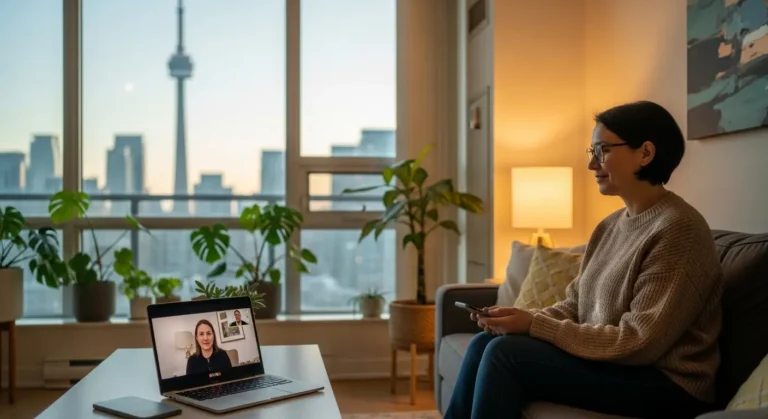

A few years ago, if someone had told me that most of my therapy practice would happen through a screen, I might have been skeptical. There’s something undeniably powerful about being in the same room as another person—the subtle shifts in energy, the shared silence, the simple act of showing up somewhere.
But here’s what I’ve learned after years of providing virtual therapy across Ontario: connection isn’t about physical proximity. It’s about presence. And presence can absolutely happen through a screen.
If you’re reading this, you’re probably weighing your options. Maybe you’ve only ever done in-person therapy and wonder if online sessions would feel “real.” Or perhaps you’ve never been to therapy at all, and the idea of doing it from home feels less intimidating than walking into a clinic.
Either way, I want to help you make a decision that actually fits your life—not one based on assumptions or outdated ideas about what therapy “should” look like.
The Honest Truth About Online Therapy
Let’s start with what the research tells us, because I know that matters.
Multiple studies—including a comprehensive review published in the Journal of Anxiety Disorders—have found that online therapy is just as effective as in-person therapy for treating conditions like anxiety, depression, and OCD. The therapeutic relationship, which is really the foundation of any meaningful therapy, develops just as strongly in virtual settings.
I’ve seen this firsthand. Clients who were initially hesitant about video sessions often tell me, after a few weeks, that they forget we’re not in the same room. The conversation flows. The tears come when they need to. The breakthroughs happen.
This isn’t about technology replacing human connection—it’s about technology removing barriers to it.
What Virtual Therapy Actually Looks Like
If you’ve never done online therapy before, you might be wondering what a session actually involves. Here’s what you can expect when working with me:
Before your session: You’ll receive a secure link to our video platform. All you need is a private space, a decent internet connection, and a device with a camera. Most people use their laptop or phone.
During your session: We meet face-to-face through video, just like a FaceTime or Zoom call, but through a platform designed specifically for healthcare that keeps your information confidential. We talk, just like we would in an office. I can see your expressions, you can see mine. If you need to grab a tissue or take a moment, you do. It feels remarkably normal.
Between sessions: I’m available by email if something comes up. And because you’re not spending time commuting, that extra hour (or more, if you’re dealing with Toronto traffic) is yours.
The Real Benefits of Online Therapy in Ontario
I want to be honest with you—I’m biased. My entire practice is virtual, and that’s a deliberate choice. Here’s why I believe in this model:
You Can Access Therapy From Anywhere in Ontario
This is huge. Whether you’re in downtown Toronto, a small town in Northern Ontario, or somewhere in between, you can access the same quality of care. I work with clients across the province—from the GTA to communities where the nearest therapist might be hours away.
For people dealing with life transitions like relocation, this continuity matters. Your therapy doesn’t have to pause just because your address changed.
Your Home Can Be Your Safe Space
For many people, especially those working through anxiety disorders or difficult emotions, the comfort of home makes opening up easier. You’re in your own environment, surrounded by familiar things. Your pet might be nearby. You can wrap yourself in a blanket if you need to.
I’ve had clients tell me they share things in virtual sessions that they’re not sure they would have said in an office. There’s something about being in your own space that can lower the walls a little.
No Commute Means One Less Barrier
Let’s be practical for a moment. Life is busy. Between work, family, and everything else competing for your time, adding a commute to therapy can feel like one more thing on an impossible list.
Virtual therapy eliminates that barrier entirely. Your lunch break can become your therapy hour. You can have a session right after putting the kids to bed. You’re not rushing through traffic or trying to find parking.
I’ve written before about how many therapy sessions people typically need—and consistency is a big factor in getting results. When therapy is easier to fit into your life, you’re more likely to show up for it.
Privacy That Matters
Some people don’t want to be seen walking into a therapist’s office. That might be because of stigma, because they live in a small community, or simply because they prefer to keep their mental health journey private.
With online therapy, no one knows you’re in session except you. You can take a call from your car during lunch, your bedroom, or wherever you feel most comfortable and private.
When In-Person Therapy Might Be a Better Fit
I believe in being transparent. Online therapy isn’t the right choice for everyone, and there are situations where in-person support might serve you better:
If you’re in crisis: If you’re experiencing thoughts of self-harm, severe symptoms, or a mental health emergency, you need immediate, in-person support. Please reach out to a crisis line or go to your nearest emergency room.
If technology is a barrier: Some people find video calls frustrating or anxiety-provoking in themselves. If the technology feels like it’s getting in the way of connection rather than enabling it, that’s worth paying attention to.
If you need a structured environment: For some people, physically going somewhere for therapy creates helpful separation between “therapy time” and the rest of life. If you know you’d be distracted at home, an office setting might work better.
Certain therapeutic modalities: Some specialized treatments—like certain trauma therapies involving physical techniques—may work better in person. We can discuss this if it’s relevant to your needs.
The right format is the one that helps you actually engage in the work. There’s no universal answer.
What Makes a Good Online Therapist?
Not all virtual therapy is created equal. If you’re considering this option, here are some things to look for:
Proper credentials and registration: In Ontario, make sure your therapist is registered with a regulatory college. As a Registered Social Worker (RSW), I’m regulated by the Ontario College of Social Workers and Social Service Workers, which means I’m held to professional and ethical standards. This matters for your protection.
Experience with virtual delivery: Providing therapy online requires some different skills than in-person work. You want someone who’s comfortable with the technology and has adapted their approach for the virtual format.
Evidence-based approaches: Look for therapists trained in modalities that have research behind them. I use Cognitive Behavioural Therapy (CBT) and Dialectical Behaviour Therapy (DBT) because they’re proven to help with the conditions I treat—and they translate well to virtual settings.
A good fit: This is true for any therapy, but it’s worth emphasizing. The relationship between you and your therapist matters more than almost anything else. If you don’t feel comfortable, it’s okay to keep looking.
A Note on Insurance Coverage
One question I hear often: “Will my insurance cover online therapy?”
The good news is that most extended health benefit plans in Ontario cover psychotherapy provided by Registered Social Workers, whether it’s delivered in-person or virtually. You’ll want to check your specific plan for details about coverage amounts and any requirements.
When you book with me, I provide receipts that you can submit to your insurance provider for reimbursement. It’s the same process as in-person therapy.
Who Thrives in Online Therapy?
In my experience, virtual therapy works particularly well for:
- Busy professionals juggling demanding schedules who need flexibility
- Parents who can’t easily arrange childcare for appointments
- People in remote or underserved areas with limited local options
- Anyone dealing with anxiety who finds leaving home challenging
- Individuals navigating relationship challenges who want private, convenient support
- People going through major life changes who need consistent care regardless of location
But honestly? I’ve worked with people from all walks of life who’ve found virtual therapy to be exactly what they needed. Sometimes you don’t know until you try.
What I Want You to Know
Reaching out for therapy—in any format—takes courage. If you’ve made it this far in this article, you’re already doing the work of figuring out what kind of support might help.
Here’s what I want you to take away:
Online therapy isn’t a compromise or a “second-best” option. For many people, it’s actually a better fit than in-person sessions ever were. It’s real therapy, with real results, delivered in a way that meets you where you are.
The format matters less than showing up. What changes lives is the relationship you build with your therapist, the insights you gain about yourself, and the skills you develop to navigate whatever you’re facing.
If virtual therapy sounds like it might work for you, I’d love to talk. I offer free consultations where we can discuss what you’re going through and whether we’d be a good fit—no pressure, no commitment.
Book a free consultation and let’s figure out together what your next step looks like.
Frequently Asked Questions About Online Therapy
Is online therapy as effective as in-person therapy?
Yes. Research consistently shows that online therapy produces equivalent outcomes to in-person therapy for most conditions, including anxiety, depression, and OCD. The quality of the therapeutic relationship—not the delivery method—is what predicts success.
What technology do I need for virtual therapy sessions?
You need a device with a camera (smartphone, tablet, or computer), a stable internet connection, and a private space where you won’t be interrupted. That’s it. I use a secure, healthcare-compliant video platform that’s easy to access.
Is online therapy covered by insurance in Ontario?
Most extended health benefit plans cover psychotherapy provided by Registered Social Workers, regardless of whether sessions are virtual or in-person. Check your specific plan for coverage details, and I’ll provide receipts for reimbursement.
How do I know if online therapy is right for me?
Consider your lifestyle, comfort with technology, and what environment helps you open up. If you value convenience, privacy, and flexibility—and you have a private space for sessions—virtual therapy is worth trying. Many people who were initially unsure find they prefer it.
Can you treat serious conditions like OCD through online therapy?
Absolutely. I provide specialized OCD treatment, including Exposure and Response Prevention (ERP), through virtual sessions. Research supports the effectiveness of online delivery for OCD treatment, and many clients find the ability to do exposures in their real-life environment particularly helpful.
Laura Davidson, MSW, RSW, is a Registered Social Worker providing virtual therapy services across Ontario. She specializes in treating anxiety disorders, depression, OCD, emotion regulation challenges, and life transitions using evidence-based approaches including CBT and DBT.