
If you’ve been researching anxiety treatment, you’ve probably come across the term CBT. It shows up everywhere — on therapist websites, in self-help books, recommended by doctors. But what actually is Cognitive Behavioural Therapy, and why does everyone seem to think it’s the answer to anxiety?
I’ve been using CBT with clients for years — including during my time working alongside clinical teams at CAMH and SickKids, where I saw firsthand how structured, evidence-based approaches could shift patterns that felt permanent. And I’ll be honest: CBT isn’t magic. It won’t make your anxiety disappear overnight. But it is one of the most practical, research-backed approaches we have for understanding why anxiety takes hold and — more importantly — what you can actually do about it.
In this post, I want to pull back the curtain on what CBT actually involves, why it works, and give you real exercises you can start using today. Because while working with a Registered Social Worker who specializes in anxiety makes a significant difference, there are tools you can begin practising on your own right now.
What Is CBT, Really?
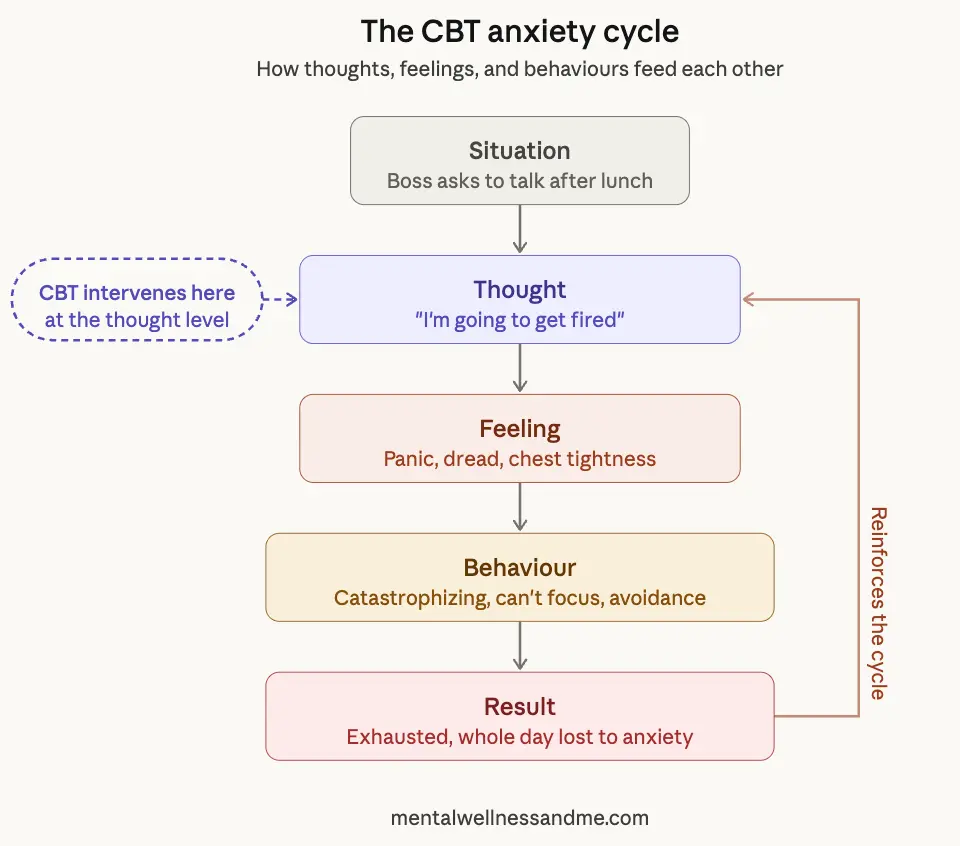
At its core, Cognitive Behavioural Therapy is based on a simple but powerful idea: the way we think affects the way we feel, and the way we feel affects the way we behave.
When you’re struggling with anxiety, this cycle often looks something like this:
Situation: Your boss asks to speak with you after lunch.
Thought: “I’m going to get fired. I must have done something wrong.”
Feeling: Panic, dread, tightness in your chest.
Behaviour: You spend the next three hours catastrophizing, can’t focus on work, maybe even consider calling in sick.
Result: By the time the meeting happens (and it turns out to be about a new project), you’re exhausted and your whole day has been hijacked by anxiety.
Sound familiar?
CBT works by helping you notice these patterns and intervene at the thought level — before the emotional spiral takes over. It’s not about thinking positively or pretending everything is fine. It’s about thinking accurately and responding to situations based on evidence rather than fear.
This is something I work on regularly with clients in my virtual anxiety therapy sessions. That moment between thought and reaction? That’s where the real change happens.
Why CBT Works for Anxiety (And What 2025–2026 Research Tells Us)
Anxiety is, in many ways, a thinking problem. Not because you’re “thinking wrong” or because it’s “all in your head” — but because anxious brains have learned to interpret the world through a threat-focused lens.
This makes sense from an evolutionary perspective. Our brains are wired to keep us safe, which means they’re constantly scanning for danger. The problem is that in modern life, this system often misfires. Your brain treats an awkward social interaction the same way it would treat a predator. A work deadline triggers the same fight-or-flight response as physical danger.
CBT helps you retrain this system. Through specific techniques, you learn to:
- Recognize when your brain is overestimating threat
- Challenge thoughts that aren’t based in reality
- Gradually face situations you’ve been avoiding
- Build confidence in your ability to handle discomfort
The research supporting CBT for anxiety is stronger than ever. A December 2025 randomized clinical trial published in JAMA Network Open studied adults with severe generalized anxiety disorder and found that digital CBT delivered through a smartphone app led to remission in more than 75% of participants — all of whom started with severe symptoms. Even the control group, which received only basic psychoeducation about anxiety, saw over 50% remission rates. That’s a striking result: structured CBT techniques are so effective that even learning about them makes a measurable difference.
And this builds on what we already knew. Research consistently shows that CBT is one of the most effective treatments for anxiety disorders — including generalized anxiety, social anxiety, panic disorder, and specific phobias. A 2025 network meta-analysis published in Translational Psychiatry confirmed that individual CBT outperforms most other delivery formats for generalized anxiety disorder.
What I find most meaningful for my clients is this: unlike medication alone, the skills you learn in CBT stay with you long after therapy ends. You’re not just managing symptoms — you’re building a toolkit you carry for life.
What CBT for Anxiety Looks Like in Practice
When you work with a CBT-trained practitioner, sessions are typically structured and goal-oriented. This isn’t the kind of therapy where you lie on a couch and talk about your childhood for years (though we might explore past experiences if they’re relevant).
Instead, CBT is collaborative and practical. Here’s what you can expect:
Understanding your patterns. We’ll map out your specific anxiety triggers, the thoughts that fuel your anxiety, and the behaviours that might be keeping you stuck. This is where my training in both CBT and emotion regulation approaches helps — we look at the full picture, not just isolated symptoms.
Learning new skills. Each session introduces tools and techniques you can use between sessions. Therapy isn’t just about the hour we spend together — it’s about what you practise in your daily life.
Homework (yes, really). CBT involves exercises to complete between sessions. This might include tracking your thoughts, practising relaxation techniques, or gradually facing situations you’ve been avoiding.
Measuring progress. We’ll regularly check in on how you’re doing and adjust our approach based on what’s working.
This structured approach is one of the reasons CBT tends to be shorter-term than other forms of therapy. Many people see significant improvement within 12–20 sessions, though this varies depending on your specific situation. If you’re curious about therapy timelines, I’ve written more about how long therapy typically takes to see results.
Common Thinking Patterns That Fuel Anxiety
One of the first things we do in CBT is help you recognize cognitive distortions — patterns of thinking that seem logical in the moment but actually distort reality in ways that increase anxiety.
Here are some of the most common ones I see with clients:
Catastrophizing: Jumping to the worst-case scenario. “If I make a mistake in this presentation, I’ll lose my job and never find another one.”
Mind reading: Assuming you know what others are thinking (usually that they’re judging you negatively). “Everyone at this party thinks I’m awkward.”
Fortune telling: Predicting the future with certainty, usually negatively. “This date is going to be a disaster.”
All-or-nothing thinking: Seeing things in black and white with no middle ground. “If I can’t do this perfectly, I shouldn’t do it at all.”
Should statements: Rigid rules about how things must be. “I should be able to handle this without feeling anxious.”
Discounting the positive: Dismissing good things that happen as flukes while treating negative things as meaningful. “They only said my work was good because they felt sorry for me.”
Emotional reasoning: Treating feelings as facts. “I feel like something terrible is going to happen, so it probably will.”
Recognizing these patterns is the first step. If you notice yourself stuck in several of these, it’s worth exploring whether professional support for anxiety might help you untangle them faster than trying on your own.
Practical CBT Exercises You Can Try Today
While working with a trained Registered Social Worker provides guidance and accountability, there are CBT techniques you can start practising on your own. Here are some of my favourites — the same tools I teach in virtual therapy sessions across Ontario.
Exercise 1: The Thought Record
This is the foundational CBT exercise. When you notice anxiety rising, grab a notebook or your phone and work through these questions:
Step 1 — Describe the situation. What happened? Where were you? Who was involved? Stick to facts only. Example: “My friend didn’t respond to my text for six hours.”
Step 2 — Identify your automatic thought. What went through your mind? What did you tell yourself about the situation? Example: “She’s mad at me. I must have said something wrong. She doesn’t want to be my friend anymore.”
Step 3 — Name the emotion and rate its intensity. What did you feel? How intense was it on a scale of 0–100? Example: “Anxious (75), hurt (60), worried (80)”
Step 4 — Examine the evidence. What evidence supports this thought? What evidence contradicts it?
- Supporting: “She usually responds faster.”
- Contradicting: “She mentioned she had a busy day. She’s responded late before and it was fine. She texted me first yesterday. There could be many reasons for a delayed response.”
Step 5 — Generate a balanced alternative thought. Based on all the evidence, what’s a more realistic way to view this situation? Example: “She’s probably just busy. A delayed text doesn’t mean anything about our friendship. I’ll wait and see — if there’s actually a problem, I can address it then.”
Step 6 — Re-rate your emotions. How do you feel now? Rate the intensity again. Example: “Anxious (40), worried (30)”
The goal isn’t to eliminate the feeling entirely — it’s to bring it down to a manageable level by thinking more accurately.
Exercise 2: The Worry Time Technique
If you’re someone whose mind races with worries throughout the day, this technique can help you contain them. It’s something I recommend often to clients dealing with overthinking and rumination.
How it works:
- Schedule 15–20 minutes of “worry time” at the same time each day (not too close to bedtime).
- When worries pop up during the day, briefly note them down and tell yourself: “I’ll think about that during worry time.”
- During your scheduled worry time, review your list. For each worry, ask: Is this something I can actually control? If yes, what’s one small action I can take? If no, can I practise accepting uncertainty about this?
- When worry time is over, move on with your day.
This technique works because it gives your brain permission to worry — just not all day long. Many clients find that by the time worry time arrives, half their worries no longer seem urgent.
Exercise 3: Behavioural Experiments
Anxiety often tells us stories about what will happen if we do certain things: “If I speak up in the meeting, everyone will think I’m stupid.” “If I go to the party, I’ll have a panic attack.”
Behavioural experiments test these predictions against reality.
How it works:
- Identify your prediction. What does your anxiety say will happen? Example: “If I ask a question in the meeting, people will think I’m incompetent.”
- Rate how strongly you believe it (0–100%). Example: 80%
- Design an experiment to test it. Example: “I’ll ask one question in tomorrow’s team meeting.”
- Predict what will happen in specific, observable terms. Example: “People will roll their eyes, my boss will look annoyed, no one will answer.”
- Run the experiment and observe what actually happens. Example: “People looked at me normally. My coworker answered my question. My boss nodded.”
- Reflect. What did you learn? How does this affect your original belief? Example: “The thing I was afraid of didn’t happen. Maybe my predictions aren’t always accurate. Belief now: 40%”
Over time, behavioural experiments build real-world evidence that counteracts anxiety’s false warnings. This approach is also central to how we treat OCD using Exposure and Response Prevention (ERP) — testing feared predictions in a structured, supported way.
Feeling like these exercises resonate but you’d benefit from guidance applying them to your specific situation? Laura Davidson, MSW, RSW, offers virtual CBT-based therapy across Ontario. Book a free consultation to talk about what you’re experiencing.
Exercise 4: The 5-4-3-2-1 Grounding Technique

When anxiety becomes physical — racing heart, shallow breathing, feeling disconnected — this grounding exercise can help bring you back to the present moment.
Work through your senses:
5 things you can SEE — Look around and name five things. “Blue chair. Window. Coffee mug. Plant. My hands.”
4 things you can TOUCH — Notice physical sensations. “The fabric of my shirt. The floor under my feet. The cool air. My phone in my pocket.”
3 things you can HEAR — Listen carefully. “Traffic outside. The hum of the refrigerator. My own breathing.”
2 things you can SMELL — If you can’t smell anything obvious, move to something you can. “Coffee. Fresh air from the window.”
1 thing you can TASTE — Notice any taste in your mouth, or take a sip of water or tea.
This exercise works by activating your parasympathetic nervous system (the “rest and digest” mode) and pulling your attention away from anxious thoughts and into the present moment. It’s one of the emotion regulation techniques I use most frequently with clients who experience intense physical anxiety symptoms.
Exercise 5: The STOPP Technique
When you feel anxiety building, use this quick intervention:
S — Stop. Pause. Don’t react immediately.
T — Take a breath. One slow, deep breath. Feel your feet on the ground.
O — Observe. What am I thinking? What am I feeling in my body? What am I reacting to?
P — Pull back. Is this thought a fact or an opinion? What would I tell a friend in this situation? Will this matter in a week? A year?
P — Practise what works. What’s the most helpful thing I can do right now? What’s one small step forward?
This takes less than a minute once you’ve practised it, and it creates crucial space between trigger and reaction.
How CBT Combines with Other Therapeutic Approaches
CBT is powerful on its own, but it often works even better as part of an integrated approach — and that’s something I lean into in my practice.
For clients who struggle with intense emotions that feel impossible to control, I often incorporate Dialectical Behaviour Therapy (DBT) skills alongside CBT. Where CBT focuses on changing unhelpful thought patterns, DBT adds tools for distress tolerance and emotional regulation — the ability to sit with intense feelings without being overwhelmed by them. This combination is especially helpful when anxiety shows up alongside emotional reactivity, relationship difficulties, or patterns of avoidance.
For clients dealing with OCD and intrusive thoughts, CBT forms the foundation, but the real heavy lifting comes from Exposure and Response Prevention (ERP). ERP is a specialized form of CBT that helps you gradually face the thoughts and situations you’ve been avoiding without performing the compulsive behaviours that temporarily relieve anxiety. I’ve written more about how ERP works in virtual therapy if you’re curious about that approach.
And beyond specific therapeutic approaches, healthy daily habits support your progress. Regular physical exercise has been shown to reduce anxiety symptoms significantly. Good sleep hygiene, consistent self-care practices, and limiting caffeine can all make your CBT work more effective.
Anxiety in Canada: Why This Matters Right Now
If you’re reading this from Ontario — or anywhere in Canada — you’re not alone in what you’re experiencing. According to CAMH and Statistics Canada data, approximately 13.3% of Canadians will experience generalized anxiety disorder in their lifetime. The Canadian Institute for Health Information (CIHI) reports that about 1 in 5 Canadians experience mental health or substance use issues in any given year, and many still struggle to find care that’s timely and meets their needs.
What I’ve noticed in my own virtual practice is that demand for anxiety support has grown steadily. Many of my clients across Ontario — from Toronto and Mississauga to Ottawa, Hamilton, and smaller communities — tell me they spent months or even years trying to manage anxiety on their own before reaching out. Part of what I love about offering virtual therapy across the province is that geography is no longer a barrier. Whether you’re in downtown Toronto or a rural community in Northern Ontario, the same evidence-based treatment is available through a secure virtual session.
When to Seek Professional Support
These exercises are genuinely helpful — but they’re not a replacement for working with a trained professional, especially if:
- Your anxiety significantly impacts your daily life, work, or relationships
- You’ve been struggling for more than a few weeks
- You’re experiencing panic attacks
- You’re avoiding important situations or activities because of anxiety
- Anxiety is affecting your relationships or your ability to cope with life changes
- Self-help strategies aren’t making enough of a difference
- You’re noticing symptoms of depression alongside your anxiety
A Registered Social Worker trained in CBT can help you apply these techniques to your specific situation, catch blind spots you might miss on your own, and guide you through more challenging aspects of treatment like exposure work.
If you’ve been wondering whether therapy might help, I’d encourage you to explore that question. Anxiety is highly treatable, and CBT gives you skills that last a lifetime.
The Bottom Line
CBT isn’t about thinking happy thoughts or pretending anxiety doesn’t exist. It’s about developing a more accurate, flexible relationship with your own mind — one where anxious thoughts don’t automatically dictate how you feel and what you do.
The exercises in this post are a starting point. They’re the same tools I teach in virtual CBT sessions, simplified so you can begin practising them today. Some will resonate more than others. Some will take practice before they feel natural.
But here’s what I want you to take away: anxiety may feel overwhelming, but it responds to treatment. The thoughts that feel so true and urgent right now? They can change. And with the right tools, you can be the one to change them.
If you’re ready to work on your anxiety with professional support, I offer virtual CBT-based therapy across Ontario. Book a free consultation and let’s talk about what you’re experiencing.
Quick Reference: CBT Exercises for Anxiety
| Exercise | Best For | Time Needed |
|---|---|---|
| Thought Record | Challenging anxious thoughts | 10–15 minutes |
| Worry Time | Constant rumination | 15–20 minutes daily |
| Behavioural Experiments | Avoidance and fear | Varies |
| 5-4-3-2-1 Grounding | Panic and physical anxiety | 2–3 minutes |
| STOPP Technique | In-the-moment anxiety | 1 minute |
Frequently Asked Questions About CBT for Anxiety
Most people begin noticing some improvement within 6–8 sessions, with more significant changes typically occurring over 12–20 sessions. However, this varies depending on the severity of your anxiety, whether you’re dealing with additional concerns like depression or OCD, and how consistently you practise techniques between sessions.
Self-help CBT can be beneficial for mild anxiety, and the exercises in this article are a good starting point. However, working with a trained Registered Social Worker is recommended for moderate to severe anxiety, as they can tailor the approach to your specific needs and guide you through more challenging techniques like exposure therapy for OCD and phobias.
Research shows that CBT is as effective as medication for most anxiety disorders, and the benefits tend to last longer after treatment ends. The December 2025 JAMA Network Open trial found that structured CBT techniques led to remission in the majority of participants with severe anxiety — without medication. Some people benefit from combining CBT with medication, especially initially. This is a personal decision best made with your healthcare provider.
CBT focuses specifically on the connection between thoughts, feelings, and behaviours, and emphasises learning practical skills to challenge unhelpful thinking. DBT builds on CBT principles while adding skills for distress tolerance and emotional regulation — it’s especially helpful for people who experience emotions very intensely or struggle with interpersonal patterns.
CBT has strong research support for generalized anxiety disorder, social anxiety, panic disorder, specific phobias, and health anxiety. It’s also the foundation of treatment for OCD (often combined with ERP) and anxiety related to trauma. A 2025 meta-analysis confirmed that individual CBT remains the gold standard across these conditions.
Absolutely. Virtual CBT is well-supported by research and is how I deliver all of my sessions. You can access evidence-based anxiety therapy from anywhere in Ontario through secure video sessions — no commute, no waiting room. Research published in 2025 found that online CBT produces meaningful reductions in anxiety symptoms comparable to in-person delivery.
Laura Davidson, MSW, RSW, is a Registered Social Worker providing virtual therapy services across Ontario. Trained in Cognitive Behavioural Therapy (CBT) and Dialectical Behaviour Therapy (DBT), she specialises in anxiety disorders, depression, OCD, and emotion regulation. Laura brings clinical experience from SickKids, CAMH (Centre for Addiction and Mental Health), and Ontario Shores to her private practice at Mental Wellness and Me.